Trump Honors Three U.S. Army Heroes with Medal of Honor in White House Ceremony Spanning Generations of Valor
The event highlighted the enduring commitment of American service members, as Trump praised their "unsurpassed courage" and selflessness in defending freedom and protecting others under extreme peril.
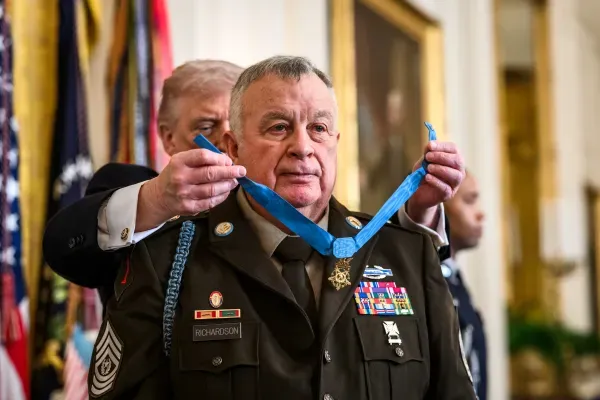
WASHINGTON – President Trump presented the Medal of Honor, the nation's highest military award for valor, to three U.S. Army soldiers during a March 2 ceremony at the White House, recognizing acts of extraordinary bravery from World War II, the Vietnam War, and the War in Afghanistan, with two awards given posthumously.
The event highlighted the enduring commitment of American service members, as Trump praised their "unsurpassed courage" and selflessness in defending freedom and protecting others under extreme peril. Attendees included family members, surviving comrades, and military leaders, underscoring the lasting impact of their heroism.
Master Sergeant Roderick "Roddie" W. Edmonds received the award posthumously for his defiance as a prisoner of war in Nazi Germany during World War II. Captured in December 1944 during the Battle of the Bulge, Edmonds was the senior non-commissioned officer at Stalag IXA near Ziegenhain. On January 27, 1945, the German commandant ordered Jewish-American POWs to identify themselves for segregation, threatening execution. Edmonds refused, ordering all 1,275 American prisoners to stand together and declaring, "We are all Jews here." When the commandant pressed a pistol to his forehead, Edmonds held firm, citing the Geneva Convention and warning of postwar prosecution for war crimes. His stand saved over 200 Jewish soldiers from likely persecution or death. Later, in March 1945, Edmonds orchestrated resistance to a forced evacuation, forcing the Germans to abandon the camp and leave the prisoners behind. Edmonds passed away in 1985; his son, Chris Edmonds, accepted the medal after uncovering the story through wartime diaries and survivor testimonies.
Staff Sergeant Michael H. Ollis was honored posthumously for his actions on August 28, 2013, at Forward Operating Base Ghazni in Afghanistan. During a complex Taliban assault involving a vehicle-borne improvised explosive device and multiple insurgents, Ollis secured his team before confronting attackers without cover. Spotting a suicide bomber approaching a wounded Polish ally, Lieutenant Karol Cierpica, Ollis charged forward and shielded Cierpica with his body, absorbing the blast that killed him. His sacrifice saved Cierpica's life. Ollis' parents, Linda and Robert Ollis from Staten Island, New York, accepted the medal. Cierpica, who attended the ceremony and named his son Michael in honor of Ollis, referred to the Ollis family as his "second family" and the U.S. as his "second homeland."
Retired Command Sergeant Major Terry P. Richardson, the sole living recipient, was recognized for his gallantry on September 12, 1968, during a reconnaissance mission on Hill 222 in Vietnam's Quang Ngai Province. As a platoon leader with Alpha Company, 1st Battalion, 20th Infantry Regiment, 11th Infantry Brigade, Americal Division, Richardson's unit came under intense enemy fire from a North Vietnamese battalion. Severely wounded multiple times, he repeatedly exposed himself to rescue injured soldiers, redistributed ammunition, and directed airstrikes that repelled the attackers. His actions saved 85 lives, and he refused evacuation to remain with his men. A Michigan native, Richardson attended the ceremony with two comrades from his unit.
In his remarks, Trump recounted each soldier's story, emphasizing their disregard for personal safety to protect others. "Due to Terry's actions above and beyond the call of duty, 82 men of Alpha Company made it home," he said of Richardson. For Edmonds, Trump noted, "With total disregard for his own life, Roddie had saved over two hundred of his fellow servicemen." On Ollis, he highlighted the "profound bond" formed in battle that extended across nations.
The ceremony comes amid ongoing U.S. military operations against Iran, serving as a reminder of the sacrifices made by service members to secure American interests. These awards, spanning three major conflicts, reinforce the values of duty, honor, and resilience that define the U.S. armed forces, inspiring current generations as the nation addresses contemporary threats.
Like this article