President Trump Terminates TPS for Somalis in Minnesota Amid Fraud and Terrorism Funding Allegations
Somalia received its initial TPS designation on September 16, 1991, under President George H.W. Bush, due to ongoing civil war and instability that rendered safe return impossible.
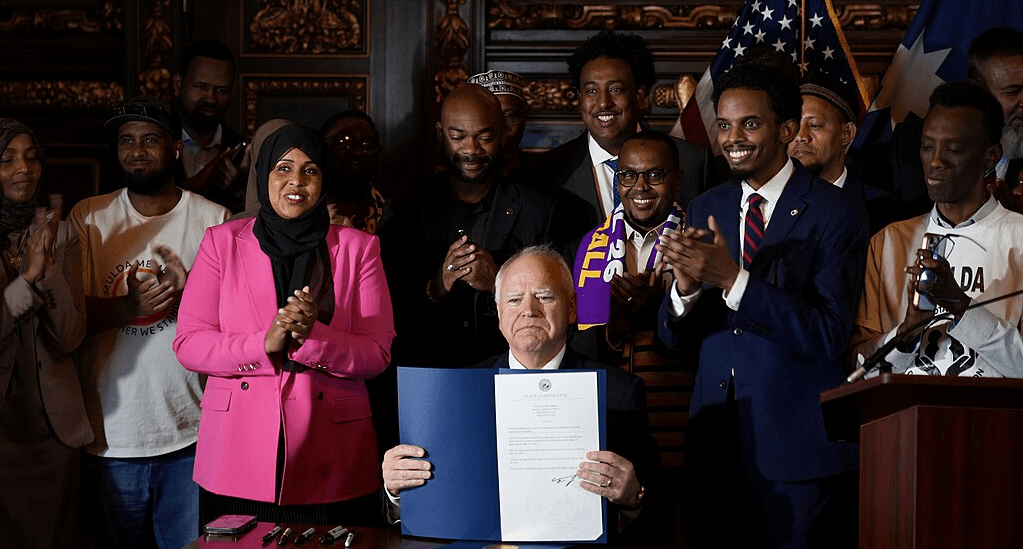
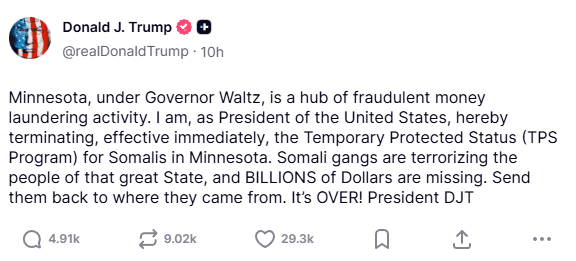
President Donald Trump announced on November 21, 2025, the immediate termination of Temporary Protected Status (TPS) for Somalis residing in Minnesota, citing the state's role as a "hub of fraudulent money laundering activity" and "Somali gangs terrorizing the people." In a Truth Social post, Trump stated, "I am, as President of the United States, hereby terminating, effective immediately, the Temporary Protected Status (TPS Program) for Somalis in Minnesota. Somali gangs are terrorizing the people of that great State, and BILLIONS of Dollars are missing. Send them back to where they came from. It’s OVER!" Minnesota hosts the largest Somali diaspora, with over 80,000 residents of Somali ancestry according to 2023 U.S. Census Bureau figures.
Somalia received its initial TPS designation on September 16, 1991, under President George H.W. Bush, due to ongoing civil war and instability that rendered safe return impossible. The status, a temporary humanitarian measure under the Immigration Act of 1990, allows eligible nationals to live and work legally in the U.S. for 18-month periods, renewable at the discretion of the Secretary of Homeland Security. Subsequent administrations, including those of Presidents Clinton, Bush, Obama, and Biden, extended it repeatedly—most recently through March 17, 2026, by DHS Secretary Alejandro Mayorkas in July 2024—citing persistent violence from groups like al-Shabaab. Over the program's 34-year history, it has shielded an estimated 4,300 Somalis as of 2024, with redesignations adding 2,200 in 2023 alone, according to USCIS reports. Beneficiaries must re-register periodically and demonstrate continuous U.S. residence since the designation date, but TPS provides no path to permanent residency.
Minnesota emerged as a primary destination for Somali refugees and TPS holders starting in the mid-1990s, drawn by robust social services, job opportunities in meatpacking and manufacturing, and a welcoming Muslim community. The influx began with voluntary resettlement programs by Lutheran Social Services and Catholic Charities, placing the first families in 1992. By 2000, the population reached 10,000; rapid growth followed, with 63,192 Somali-ancestry residents by 2023, concentrated in the Twin Cities metro area—Minneapolis-Saint Paul hosting the largest such community globally outside Somalia. Federal data shows 40,000-50,000 arrived between 1991 and 2020, many via TPS extensions, contributing to a vibrant economy with Somali-owned businesses generating $500 million annually, per the Minnesota Department of Employment and Economic Development.
However, the influx has brought significant challenges, including integration strains and crime spikes. Somali gangs like the Roughneck Somali Mafia and Somali Outlaws have been linked to 20% of Minneapolis homicides since 2015, per Hennepin County Sheriff's reports, with turf wars fueling shootings that claimed 82 lives in 2023—double the 2019 rate. Welfare dependency remains high, with 70% of Somali households receiving public assistance in 2022, according to the Minnesota Department of Human Services, exacerbating budget shortfalls amid $2 billion in annual fraud losses. Recent scandals, uncovered by the Manhattan Institute in November 2025, reveal billions bilked from programs like Feeding Our Future ($250 million in 2022) and Housing Stabilization Services ($399 million from 2018-2023), often by Somali-led rings falsifying autism diagnoses or meal claims.
Most alarmingly, federal counterterrorism sources confirmed to investigators that millions in defrauded funds have been remitted to Somalia via hawala networks—informal, clan-based transfer systems—and funneled to al-Shabaab, the al-Qaida affiliate responsible for 35,000 deaths since 2006. A City Journal probe detailed flights from Minneapolis-St. Paul carrying cash bundles, with one 2023 seizure uncovering $1.7 million destined for the group. Glenn Kerns, a retired Seattle JTTF detective, traced $10-20 million annually from Minnesota fraud to al-Shabaab coffers, stating, "The largest funder of Al-Shabaab is the Minnesota taxpayer." The group's 2024 attacks killed 200 U.S.-allied troops in Somalia, per AFRICOM data.
Trump's termination, effective immediately, revokes TPS for non-citizens, initiating deportation proceedings through ICE, though legal challenges from groups like CAIR-MN are expected. Jaylani Hussein of CAIR-MN called it a "political attack," warning of family separations. Minnesota Gov. Tim Walz, a Democrat, decried it as "cruel," but Trump tied it to fraud, echoing a September 2025 executive order combating welfare abuse. The move aligns with broader TPS terminations for Venezuelans and Haitians, affecting 1.1 million total, and could reduce Minnesota's Somali population by 5-10% over two years, per Migration Policy Institute estimates.
Like this article