Columbia University Settles with Trump Administration for $221 Million to Restore Federal Funding
The settlement includes a $200 million payment to the federal government over three years and an additional $21 million to settle U.S. Equal Employment Opportunity Commission (EEOC) investigations into discrimination against Jewish employees during protests tied to the Israel-Hamas conflict.
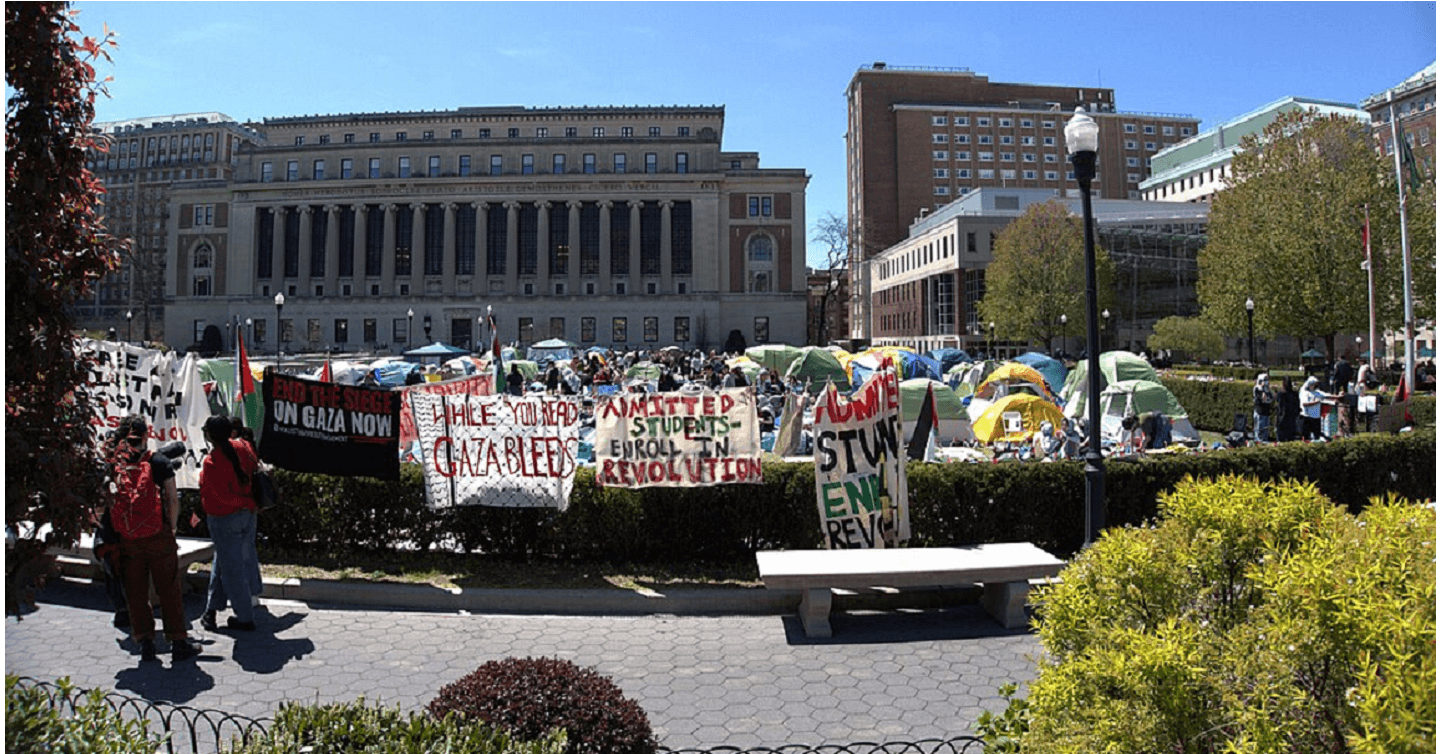
Columbia University announced on July 23, 2025, a historic settlement with the Trump administration, agreeing to pay $221 million to resolve federal investigations into alleged civil rights violations, particularly concerning antisemitism on its New York City campus. The agreement reinstates most of the $400 million in federal grants frozen or terminated in March 2025, ensuring the university’s research programs can continue. This deal marks a significant moment in addressing campus policies and restoring federal support, a priority for those who value accountability in higher education.
The settlement includes a $200 million payment to the federal government over three years and an additional $21 million to settle U.S. Equal Employment Opportunity Commission (EEOC) investigations into discrimination against Jewish employees during protests tied to the Israel-Hamas conflict, which escalated after Hamas’ October 7, 2023, attack on Israel. Columbia’s acting president, Claire Shipman, stated, “This agreement marks an important step forward after a period of sustained federal scrutiny and institutional uncertainty. The settlement was carefully crafted to protect the values that define us and allow our essential research partnership with the federal government to get back on track.”
Under the terms, Columbia will implement strict policy changes to address the administration’s concerns. These include banning face masks during protests (except for health or religious reasons), empowering a new security force of 36 special officers to arrest or remove disruptive individuals, and coordinating with the New York Police Department to prevent incidents like the 2024 anti-Israel takeover of Hamilton Hall. The university will also overhaul its disciplinary process, moving oversight from the faculty senate to the Office of the Provost, and has already announced suspensions and expulsions for students involved in disruptive protests, including a recent library demonstration and last year’s anti-Israel encampment.
Columbia’s academic programs, particularly its Middle Eastern, South Asian, and African Studies department, will face rigorous review by a senior vice provost to ensure “comprehensive and balanced” curricula. This includes scrutiny of the Center for Palestine Studies, the Institute for Israel and Jewish Studies, and learning hubs in Tel Aviv and Amman, Jordan. The university will also enhance vetting of international students, requiring them to disclose their reasons for studying in the U.S. and sharing disciplinary data with federal authorities under the Student and Exchange Visitor Program.
The agreement aligns with the Supreme Court’s 2023 ruling against race-based affirmative action, requiring Columbia to end discriminatory programming and create faculty positions to promote intellectual diversity. Additionally, the university will comply with Title IX, ensuring women are not forced to compete with or share facilities with biological men. A jointly selected independent monitor will oversee compliance, reporting to the government every six months.
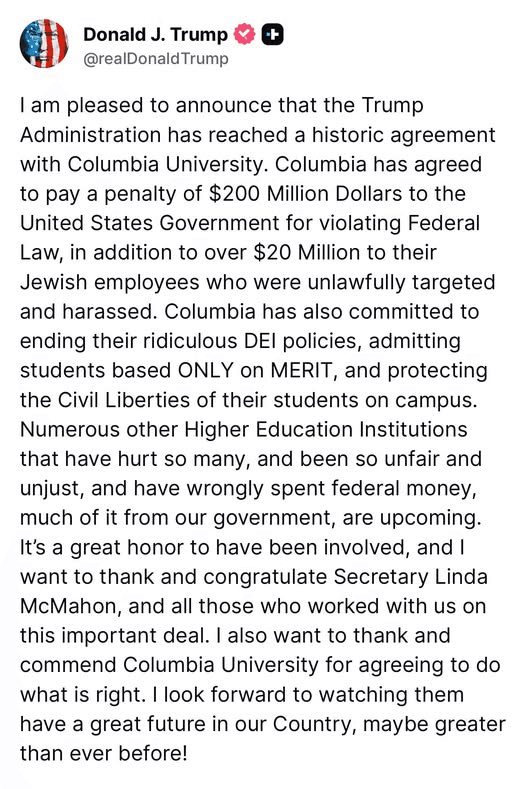
The Trump administration’s actions stem from accusations that Columbia failed to protect Jewish students and faculty from harassment during pro-Palestinian protests sparked by the Israel-Hamas war. Education Secretary Linda McMahon called the settlement “a seismic shift in our nation’s fight to hold institutions that accept American taxpayer dollars accountable for antisemitic discrimination and harassment.” President Trump, posting on Truth Social, celebrated the deal, stating, “Columbia has agreed to pay a penalty of $200 Million Dollars to the United States Government for violating Federal Law, in addition to over $20 Million to their Jewish employees who were unlawfully targeted and harassed.” He signaled that other universities could face similar scrutiny.
While Columbia does not admit wrongdoing, Shipman acknowledged that “Jewish students and faculty have experienced painful, unacceptable incidents, and that reform was and is needed.” The university’s $14 billion endowment cushioned the financial blow, but the loss of $400 million in grants had strained research operations, with an additional $1.2 billion in potential National Institutes of Health funding at risk. The settlement averts further financial damage and restores Columbia’s eligibility for future federal grants.
The deal has sparked debate. Some faculty, including Michael Thaddeus of the American Association of University Professors, expressed concern that the independent monitor could infringe on academic freedom, particularly in admissions and curriculum decisions. Others see the settlement as a necessary step to restore stability and protect students. Unlike Harvard, which is suing the administration over $2.6 billion in funding cuts, Columbia’s less confrontational approach facilitated the agreement.
This settlement sets a precedent for other universities under federal investigation for similar issues. With over 4,000 grants worth $8 billion targeted across 600 institutions, the Trump administration’s push for accountability in higher education shows no signs of slowing. For those who prioritize fairness and safety on campus, Columbia’s agreement signals a commitment to addressing past failures while navigating the complex balance of academic independence and federal oversight.
Like this article