Antifa Violence Targets AfD Youth Congress in Germany, Echoing Tactics of Hitler's Brownshirts
The demonstration, estimated at 25,000 to 30,000 participants by Hesse state authorities, delayed the event by over two hours as demonstrators erected 19 roadblocks on highways and bridges, assaulted officers with stones, bottles, and flares, and injured at least 10 to 15 police personnel
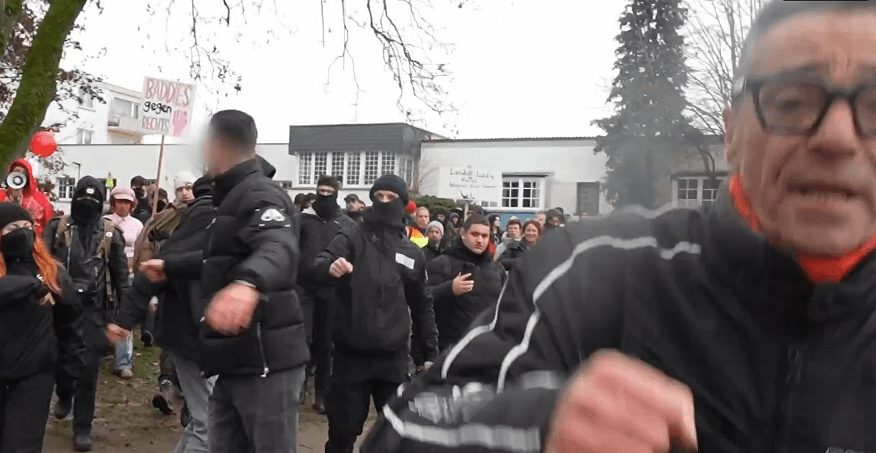
Thousands of left-wing protesters, including members of the Antifa network, clashed with police in Giessen, Germany, on November 29, 2025, attempting to disrupt the founding congress of Generation Deutschland, the new youth wing of the Alternative for Germany (AfD) party. The demonstration, estimated at 25,000 to 30,000 participants by Hesse state authorities, delayed the event by over two hours as demonstrators erected 19 roadblocks on highways and bridges, assaulted officers with stones, bottles, and flares, and injured at least 10 to 15 police personnel. The deployment of 6,000 officers—the largest in Hesse history—prevented a full shutdown, but violence persisted, including attacks on journalists and an AfD lawmaker, underscoring Antifa's pattern of using physical force to silence political opposition.
The congress proceeded after the blocks were cleared, with Jean-Pascal Hohm, 28, elected as leader by acclamation. AfD co-chair Alice Weidel condemned the tactics as "deeply undemocratic," stating, "These extremists did not come to protest peacefully. They came to shut down a party convention by force." Generation Deutschland replaces the Junge Alternative, dissolved in March 2025 after Germany's Federal Office for the Protection of the Constitution classified it as a right-wing extremist group. The AfD, Germany's second-largest party with 20% support in February 2025 elections, positions the youth wing as a platform for young voters concerned with immigration and economic issues, amid polls showing AfD leading in eastern state races next year.
The Giessen clashes mirror Antifa's global strategy of direct action to prevent conservative gatherings, a method that parallels the Sturmabteilung (SA), or Brownshirts, in 1930s Nazi Germany. Formed in 1921 as the Nazi Party's paramilitary wing, the SA—numbering 60,000 by 1930 and 2 million by 1933—specialized in protecting Nazi events while systematically disrupting rivals' meetings through intimidation and violence. SA thugs, in brown uniforms, ambushed opposition at rallies, beat attendees, and ransacked offices, as in the March 1933 Königsberg attack where they stormed the building, killed one SPD member, and tortured others. These tactics, documented in Ernst Röhm's memoirs and the 1934 Reichstag debates, suppressed opposition by creating fear, allowing the Nazis to consolidate power without electoral competition. Historians like Richard Evans note the SA's role in over 400 political murders from 1930-1933, paving Hitler's path to chancellor in 1933.
Antifa's actions in Giessen—blocking access, assaulting police, and targeting media—evoke this playbook, where force replaces debate to marginalize dissent. The group's calls on Indymedia for "setting Giessen ablaze" and establishing checkpoints to ID attendees reflect organized suppression, not spontaneous protest. Hesse Governor Boris Rhein criticized the violence, stating, "Violence is never a legitimate means in democracy," while federal Interior Minister Alexander Dobrindt demanded Antifa's classification as extremist. The U.S. State Department, following President Trump's September 2025 designation of Antifa as a domestic terrorist organization, has expanded foreign terror labels to European cells, including Germany's "hammer gang," citing similar patterns of coordinated disruption.
The incident, with 300 initial attendees swelling to 1,000 despite delays, highlights AfD's resilience amid suppression. The party, polling at 22% nationally in November 2025 per Infratest dimap, anticipates gains in 2026 state elections, where youth turnout could favor Generation Deutschland. Police used water cannons and pepper spray to disperse flares and projectiles, arresting 12 for assault and vandalism. No serious injuries occurred, but the event underscores escalating political polarization in Germany, where AfD's rise—second in February 2025 federal elections—has prompted mainstream parties to refuse coalitions. As Antifa's tactics intensify, parallels to the SA serve as a stark reminder of how violence against assemblies can erode democratic norms.
Like this article